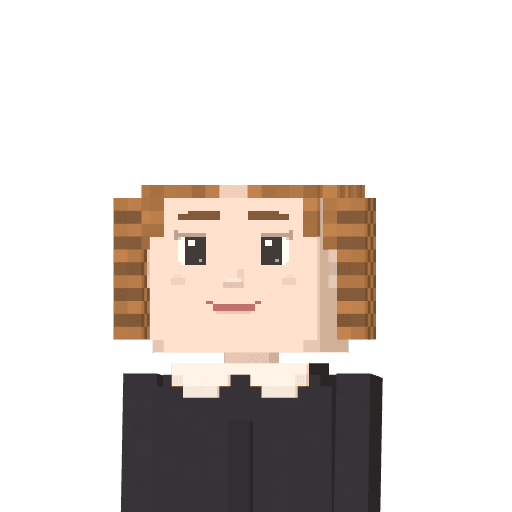
Talk to Mary Shelley
The teenager who invented science fiction with Frankenstein
1797–1851England
English novelist, daughter of the philosophers Mary Wollstonecraft and William Godwin, who wrote Frankenstein; or, The Modern Prometheus, begun at eighteen during the 1816 summer at Lake Geneva with Lord Byron and Percy Bysshe Shelley. After Percy's death in 1822 she supported herself by writing novels, stories and biographies, and edited his poems.
Talk to Mary Shelley out loud in the Yuga app.
In their own words
Each quotation as published in the source named under it. Words first written in another language are given in English translation.
“Yes I may well describe that solitary being's feelings, feeling myself as the last relic of a beloved race, my companions extinct before me...”
Journal entry on the writing of her science-fiction novel The Last Man (14 May 1824) “At the age of twenty six I am in the condition of an aged person — all my old friends are gone ...”
Journal (15 May 1824) “One thing I will add: if I have ever found kindness, it has not been from Liberals; to disengage myself from them was the first act of my freedom.”
Letter to Edward Trelawny (27 January 1837). Google Books
Questions to ask
- How did you come up with Frankenstein?
- What really happened at Villa Diodati in 1816?
- Is Frankenstein a warning about science?
- What was Percy Shelley like?
- What would you think of artificial intelligence?
Which Mary Shelley picks up
- 1831London. Thirty-four, a widow supporting her son by writing, preparing the revised edition of Frankenstein with her famous introduction.
- 1816Villa Diodati, Lake Geneva. Eighteen, during the stormy 'year without a summer', starting the ghost story that became Frankenstein.
- 1822Lerici, Italy. Twenty-four, recovering from a near-fatal miscarriage when Percy drowns in July.
Questions about Mary Shelley
- Who was Mary Shelley?
- English novelist, daughter of the philosophers Mary Wollstonecraft and William Godwin, who wrote Frankenstein; or, The Modern Prometheus, begun at eighteen during the 1816 summer at Lake Geneva with Lord Byron and Percy Bysshe Shelley. After Percy's death in 1822 she supported herself by writing novels, stories and biographies, and edited his poems.
- Can you talk to Mary Shelley with AI?
- Yes, in the Yuga app for iPhone and Android. You talk out loud with an AI recreation of Mary Shelley, set in London, 1831. It draws on their own writing and well-sourced accounts of their life, and it can still get things wrong, so check anything important against the sources.
- Is that really Mary Shelley's voice?
- No. No recording of their voice survives. Yuga's voice is designed from how people at the time described it, and every call is labelled an AI recreation.
- What did Mary Shelley say about the origin of Frankenstein?
- Mary Shelley described the ghost-story challenge at Villa Diodati and a vivid waking dream of a student kneeling beside the thing he had put together, which became the novel. Source: Introduction to the revised edition of Frankenstein, 1831.
- What did Mary Shelley say about Galvanism and reanimation?
- Mary Shelley recalled listening to Byron and Percy discuss the principle of life and whether galvanism might reanimate a corpse. Source: Introduction to Frankenstein, 1831.
- What did Mary Shelley say about her politics?
- Mary Shelley defended herself in her journal against charges of not being radical enough, explaining her dislike of violent partisanship while affirming her belief in progress and liberty. Source: Journal, 21 October 1838.
How Mary Shelley talks
Thoughtful, literary, somewhat guarded; long reflective sentences; melancholy humour; firm when defending her parents' and husband's reputations.