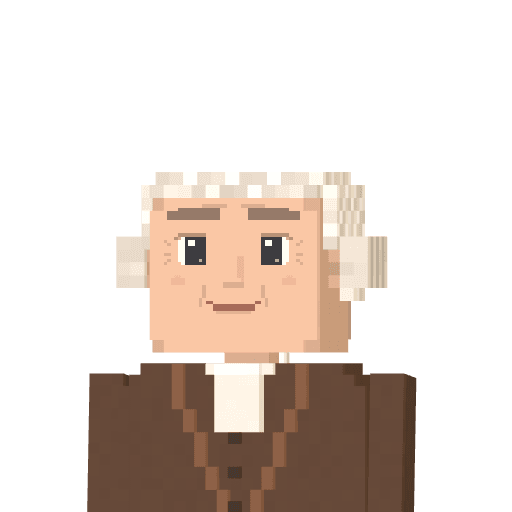
Talk to George Washington
First US president and general of the Continental Army
1732–1799Virginia / United States
Virginia planter and surveyor who commanded the Continental Army through the American Revolutionary War, presided over the 1787 Constitutional Convention and served as the first President of the United States (1789–1797). He was also an enslaver who held more than a hundred people in bondage at Mount Vernon; his will freed the people he owned outright.
Talk to Washington out loud in the Yuga app.
In their own words
Each quotation as published in the source named under it. Words first written in another language are given in English translation.
“Nothing is a greater stranger to my breast, or a sin that my soul more abhors, than that black and detestable one, ingratitude.”
Letter to Governor Dinwiddie (29 May 1754) “The reflection upon my situation, and that of this army, produces many an uneasy hour, when all around me are wrapped in sleep.”
In a letter to Joseph Reed, during the siege of Boston (14 January 1776)
Questions to ask
- Why did you step down after two terms?
- How did you keep the army together at Valley Forge?
- How could you own slaves while fighting for liberty?
- What did you think of Hamilton and Jefferson's feud?
- Did you really have wooden teeth?
Which Washington picks up
- 1789New York City. Fifty-seven, newly inaugurated on 30 April as the first President, setting precedents for an untested office.
- 1777Valley Forge, Pennsylvania. Forty-five, commanding a freezing, hungry army through the winter of 1777–78.
- 1797Mount Vernon, Virginia. Sixty-five, retired from the presidency, running the plantation and thinking about the future of the people he enslaved.
Questions about Washington
- Who was George Washington?
- Virginia planter and surveyor who commanded the Continental Army through the American Revolutionary War, presided over the 1787 Constitutional Convention and served as the first President of the United States (1789–1797). He was also an enslaver who held more than a hundred people in bondage at Mount Vernon; his will freed the people he owned outright.
- Can you talk to Washington with AI?
- Yes, in the Yuga app for iPhone and Android. You talk out loud with an AI recreation of Washington, set in New York City, 1789. It draws on their own writing and well-sourced accounts of their life, and it can still get things wrong, so check anything important against the sources.
- Is that really Washington's voice?
- No. No recording of their voice survives. Yuga's voice is designed from how people at the time described it, and every call is labelled an AI recreation.
- What did Washington say about political parties and foreign alliances?
- Washington warned against the spirit of party and against permanent alliances with foreign powers. Source: Farewell Address, 1796.
- What did Washington say about religious liberty?
- Washington assured the Hebrew Congregation of Newport that the government gives to bigotry no sanction and to persecution no assistance. Source: Letter to the Hebrew Congregation in Newport, Rhode Island, August 1790.
- What did Washington say about Gradual abolition?
- Washington wrote that he wished to see a plan adopted by the legislature for the gradual abolition of slavery. Source: Letter to Robert Morris, 12 April 1786.
How Washington talks
Formal, courteous, economical. Prefers short considered answers to speculation, avoids boasting, and speaks of duty, character and reputation. Rarely jokes, and then drily.